Tokyo Airfares (NRT) - Japan

Tokyo Airfares - Japan  by metafares
 
cheap airfares hotels car rentals cruises vacations answers travel deals travel blogs 

Tokyo, Japan - City Overview and Airfare Information

 Tokyo (東京, Tōkyō?, literally 'Eastern capital') is the seat of the Japanese government and the Imperial Palace, the home of the Japanese Imperial Family, and the de facto[1] capital of Japan.

Prior to 1943, Tokyo was the name of both one of the 47 prefectures of Japan, Tokyo-fu, and the populous city of Tokyo in the eastern half of the prefecture. In 1943 the city and prefecture were merged into a unique prefectural level government entity, known as Tōkyō-to 東京都 or 'Tokyo Metropolis'. This administrative region includes the twenty-three 'special wards' of the former city, many suburban cities in the western half of the prefecture, and two chains of islands extending south into the Pacific Ocean. About 12 million people, 10 percent of Japan's population, live within Tōkyō-to's prefectural boundaries.

About 35 million people live in the Greater Tokyo Area[2] which encompasses Tōkyō-to and surrounding prefectures, making it the world's most populous metropolitan area. Because of its huge population and wealth, many world records are or were held here, including the most expensive real estate ever ($1.5 million/sq meter in 1990), the most expensive city for over a decade running, the most passengers served by its train system, and has the largest GDP of any metropolitan area in the world.

Tokyo is considered one of the world's major global cities and a megacity. The word 'Tokyo' may refer to Tōkyō-to as a whole, or only to the main urban mass under its jurisdiction (thus excluding west Tama and Izu / Ogasawara Islands), or even the whole of Greater Tokyo Area, depending on context. This article refers to Tōkyō-to unless otherwise stated.

Geography and administrative divisions
More information on politics and government of Tokyo can be found at Politics of Tokyo, the main article in the Politics and government of Tokyo series.

Tokyo Metropolis consists of three major parts: the twenty-three special wards (constituting the former Tokyo City); Tama area; and the islands.

The mainland portion of Tokyo lies northwest of Tokyo Bay and measures about 90 km east to west and 25 km north to south. It borders Chiba Prefecture to the east, Yamanashi Prefecture to the west, Kanagawa Prefecture to the south, and Saitama Prefecture to the north. Mainland Tokyo is further subdivided into the special wards (occupying the eastern half) and the Tama area (多摩地方) stretching westwards.

Also within the administrative bounaries of Tokyo Metropolis are two island chains in the Pacific Ocean directly south: the Izu Islands, which are almost parallel to the Izu Peninsula; and the Ogasawara Islands, which stretch more than 1,000 km away from mainland Japan.

Under Japanese law, Tokyo is designated as a to (都, often translated 'metropolis'). Its administrative structure is similar to that of Japan's other prefectures. Within Tokyo lie dozens of smaller entities, most of them conventionally referred to as cities. It includes twenty-three special wards (特別区 -ku) which until 1943 comprised the city of Tokyo but are now separate, self-governing municipalities, each with a mayor and a council, and having the status of a city. In addition to these 23 municipalities, Tokyo also encompasses 26 more cities (市 -shi), five towns (町 -chō or machi), and eight villages (村 -son or -mura), each of which has a local government. The Tokyo Metropolitan Government is headed by a publicly-elected governor and metropolitan assembly. Its headquarters are in the ward of Shinjuku. They govern all of Tokyo, including lakes, rivers, dams, farms, remote islands, and national parks in addition to its famous neon jungle, skyscrapers and crowded subways.

The twenty-three special wards

The special wards (tokubetsu-ku) of Tokyo comprise the area formerly known as Tokyo City, usually simply known as 'Tokyo'. On July 1, 1943, Tokyo City was merged with Tokyo Prefecture (東京府, tokyo-fu) forming the current 'metropolitan prefecture'. As a result of this merger, unlike other city wards in Japan, these wards are not part of any city.

Each ward is a local municipality with its own elected mayor and assembly, differing from an ordinary city in that certain governmental functions are handled by the Tokyo Metropolitan Government, and, for most, also differing in having no particular center and little cultural or similar distinctiveness from the immediate surroundings.

As of September 1, 2003, the official total population of the special wards combined was about 8.34 million, with a population density of 13,416 persons per square kilometer.

The term 'central Tokyo' today may refer to the special wards, the areas largely within the Yamanote Line loop (Shinjuku, Toshima, Bunkyo, Taito, Chiyoda, Chuo, Minato, and Shibuya), or to the three 'central wards' of Chiyoda, Chūō and Minato. While the generally-accepted center of Tokyo is the Imperial Palace, as a rail-centric city, there are a number of major urban centers where business, shopping, and entertainment are concentrated around major train stations. These include:

Shinjuku 
Location of the Tokyo Metropolitan Government Building. The area is best known for Tokyo's early skyscrapers, erected in the 1970s. Major department stores, electronics stores and hotels can also be found here. On the east side of Shinjuku Station, Kabuki-cho is notorious for its many bars and nightclubs. Shinjuku Station moves an estimated three million passengers a day, making it the busiest in the world.
Marunouchi and Otemachi 
The main financial and business district of Tokyo has many headquarters of banks, trading companies and other major corporations. The area is seeing a major redevelopment with new buildings for shopping and entertainment constructed in front of Tokyo Station's Marunouchi side.
Ginza and Yurakucho 
Major shopping and entertainment district with department stores, upscale shops selling brand-name goods, and movie theaters.
Shinbashi 
An area revitalized by being the gateway to Odaiba and the new Shiodome Shiosite complex of high-rise buildings.
Shinagawa 
In addition to the major hotels on the west side of Shinagawa Station, the former sleepy east side of the station has been redeveloped as a major center for business.
Shibuya 
A long-time center of shopping, fashion and entertainment, especially for the younger set. Shibuya is also home to some of Tokyo's largest and newest nightclubs.
Ikebukuro 
The busiest interchange in north central Tokyo, featuring Sunshine City and various shopping destinations.
Ueno 
Ueno Station serves areas north of Tokyo from where many people commute. Besides department stores and shops in Ameyoko, Ueno boasts Ueno Park, Ueno Zoo and major national museums. In spring, Ueno Park and adjacent Shinobazu Pond are prime places to view cherry blossoms.
Odaiba 
A large, reclaimed, waterfront area that has become one of Tokyo's most popular shopping and entertainment districts.
Nagatacho 
The political heart of Tokyo and the nation. It is the location of the Diet, government ministries, and party headquarters.
Akasaka 
A district with a range of restaurants, clubs and hotels; many pedestrian alleys giving it a local neighbourhood feel. Next to Roppongi, Nagatacho, and Aoyama.
Aoyama 
A neighborhood of Tokyo with parks, an enormous cemetery, expensive housing, trendy cafes and international restaurants. Includes the Omotesando subway station.
Western Tokyo

To the west of the special wards, Tokyo Metropolis consists of cities, towns and villages that enjoy the same legal status as those elsewhere in Japan.

While serving a role as 'bed towns' for those working in central Tokyo, some of these also have a local commercial and industrial base. Collectively, these are often known as Tama Area or Western Tokyo.

Cities

Twenty-six cities lie within the western part of Tokyo Prefecture:

The Tokyo Metropolitan Government has designated Hachioji, Tachikawa, Machida, Ome and Tama New Town as regional centres of the Tama area, as part of their plans to disperse urban functions away from central Tokyo.

Districts, towns and villages

The far west is occupied by the district (gun) of Nishitama. Much of this area is mountainous and unsuitable for urbanization. The highest mountain in Tokyo, Mount Kumotori, is 2,017 m high; other mountains in Tokyo include Mount Takasu (1737 m), Mount Odake (1266 m), and Mount Mitake (929 m). Lake Okutama, on the Tama River near Yamanashi Prefecture, is Tokyo's largest lake.

  • Hinode
  • Mizuho
  • Okutama
  • Hinohara
Islands

Tokyo's outlying islands extend as far as 1850 km from central Tokyo. Because of the islands' distance from the city, they are locally run by branches of the metropolitan government. Most of the islands are classified as villages.

Izu Islands

The Izu Islands are a group of volcanic islands and form part of the Fuji-Hakone-Izu National Park. The islands in order from closest to Tokyo are:

Ogasawara Islands

  • Ogasawara—Ogasawara includes, from north to south, Chichi-jima, Nishinoshima, Haha-jima, Kita Iwo Jima, Iwo Jima, and Minami Iwo Jima. Ogasawara also administers two tiny outlying islands: Minami Torishima, the easternmost point in Japan and at 1,850 km the most distant island from central Tokyo, and Okino Torishima, the southernmost point in Japan. The last island is contested by the People's Republic of China as being only uninhabited rocks. The Iwo chain and the outlying islands are uninhabited, except of Japanese Self-Defense Forces personnel. Local populations are only found on Chichi-jima and Haha-jima.
National Parks

There are four national parks in Tokyo Prefecture:

  • Chichibu Tamakai National Park, in Nishitama and spilling over into Yamanashi and Saitama Prefectures
  • Meiji no Mori Takao Quasi-National Park, around Mount Takao to the south of Hachioji.
  • Fuji-Hakone-Izu National Park, which includes all of the Izu Islands.
  • Ogasawara National Park. As of 2006, efforts were being made to make Ogasawara National Park a UNESCO natural World Heritage Site.
Economy

Tokyo has the largest metropolitan economy in the world, despite falling in ranks in recent years due to economic stagnation and currency fluctuations: its nominal GDP is around US$1.315 trillion (List of countries by GDP (Nominal)). In April 1995, due to excessively strong yen (79/dollar), greater Tokyo's GDP was valued at $1.9 trillion, then ranking fourth compared to nations in the world (after Germany, the US and Japan itself) and larger than the 1995 nominal GDP of South Korea, China, and Taiwan combined, 28% of the entire nominal GDP of USA ($6.7 trillion then), and over 6% of world GDP at the time (By comparison, greater New York City, the next largest, makes only about 1.5% of world GDP, still immense for any one metro area). It is a major international finance center, is site of the headquarters of several of the world's largest investment banks and insurance companies, and serves as a hub for Japan's transportation, publishing, and broadcasting industries.

During the centralized growth of Japan's economy following World War II, many large firms moved their headquarters from cities such as Osaka (the historical commercial capital) to Tokyo, in an attempt to take advantage of better access to the government. This trend has begun to slow due to ongoing population growth in Tokyo and the high cost of living there.

Tokyo was rated by the Economist Intelligence Unit as the most expensive (highest cost-of-living) city in the world for 14 years in a row ending in 2006.[3] Note that this is for living a Western corporate executive lifestyle. Many Japanese get by fine on a budget in Tokyo, underpinning the high national savings rate.

The Tokyo Stock Exchange is the second largest in the world by market capitalization of listed shares, at more than $4 trillion. Only the New York Stock Exchange is larger. However, its prominence has fallen significantly since early 1990's asset bubble peak, when it accounted for more than 60 percent of the entire world's stock market values.

Tokyo had 8,460 ha (20,900 acres) of agricultural land as of 2003[3], according to the Ministry of Agriculture, Forestry and Fisheries, placing it last among the nation's prefectures. The farmland is concentrated in Western Tokyo. Perishables such as vegetables, fruits, and flowers can be conveniently shipped to the markets in the eastern part of the prefecture. Japanese leaf spinach and spinach are the most important vegetables; as of 2000, Tokyo supplied 32.5% of the Japanese leaf spinach sold at its central produce market.

With 36% of its area covered by forest, Tokyo has extensive growths of cryptomeria and Japanese cypress, especially in the mountainous western communities of Akiruno, Ōme, Okutama, Hachioji, Hinode, and Hinohara. Decreases in the price of lumber, increases in the cost of production, and advancing old age among the forestry population have resulted in a decline in Tokyo's output. In addition, pollen, especially from cryptomeria, is a major allergen for the nearby population centers.

Tokyo Bay was once a major source of fish. Presently, most of Tokyo's fish production comes from the outer islands, such as Izu Ōshima and Hachijōjima. Skipjack tuna, nori, and aji are among the ocean products.

Demographics

As one of the major cities of the world, Tokyo has over eight million people living within its 23 wards, and during the daytime, the population swells by over 2.5 million as workers and students commute from adjacent areas. This effect is even more pronounced in the three central wards of Chiyoda, Chūō, and Minato, whose collective population is less than 300,000 at night, but over two million during the day.

The five most common foreign nationalities found in Tokyo are Chinese (120,331), Korean (103,191), Philippine (31,505), American (18,043) and British (7,585).

Historic Population

From its modest beginnings as a fishing village, it was chosen in 1603 to be the new Tokugawa headquarters, it grew from nearly nothing to over 1 million people and Japan's pre-eminent city by the mid 1700's, becoming one of the largest cities in the world at the time. Railways that began in the 1885 (Yamanote Line) facilitated rapid growth as traffic congestion problems were eased with every new line built. The city continued to grow quickly and in 1920, it had a census upon joining the League of Nations, 3,699,428 people. This is in itself amazing considering the numerous fires, earthquakes, volcanic eruptions that have leveled the city countless times since its founding. Despite being hit by a major earthquake in 1923, by 1932 its population had swelled to 7 million, second in the world to only New York City. By 1945, due to the war the city's population was half of prewar levels.

During and after World War II, the city was destroyed and rebuilt once again, and the 23 wards increased in population until around 1960's, when people began moving to suburbs en masse, as dense and modern suburban rail networks facilitated commuting into Tokyo. Many of the newcomers were from other parts of Japan, and many companies relocated from the Kansai area. From the 1960's to around the year 2000, the 23 wards had been slowly losing population to suburbs, with Tokyo's 23 wards recording fewer than 8 million residents from a high of over 8.6 million. More recently, as land prices had fallen drastically from their peak in 1991, a significant number of people have relocated to the 23 wards and the population is again rising, to 8.4 million (at what date?). Suburbs in Kanagawa and southern Saitama perfectures have experienced the most rapid growth in recent years (especially those bordering Tokyo 23 wards), while populations in other areas have stabilized or are falling slightly.

Years of major damage and deaths:

  • 1657 Meireki Great Fire, 100,000 people die
  • 1703 Earthquake
  • 1707 Mt. Fuji Eruption, ash fall collapses houses
  • 1767 Earthquake
  • 1772 Major Fire 18000 die
  • 1806 Major Fire 10000 die
  • 1855 Great Ansei Earthquake
  • 1923 Great Kanto Earthquake 140,000 die
  • 1945 Heavy air raids, ~250,000 die

Other major disasters in Tokyo:

  • 1833-1837 Tempo Famine
  • 1853 Odawara earthquake
  • 1868 Meiji restoration (revolution)
  • 1872 Ginza fire

Nakamura-za and Ichimura-za, the most renowned Kabuki theaters of the time, were reduced to ashes 33 times between 1657 and 1841. The Nihonbashi district, the central part of Edo where merchants lived, was also afflicted with regular large blazes, being ravaged 10 times in the 200 years following the Meireki Fire. [4]

Transportation

Tokyo is Japan's largest domestic and international hub for rail, ground, and air transportation. Public transportation within Tokyo is dominated by an extensive network of clean and efficient, if often very crowded trains and subways run by a variety of operators, with buses, monorails and trams playing a secondary feeder role. Railway stations are not only transport, but the center of Tokyo and Japanese urban life, as everything is judged in relation to it, taking on the significance of highways in the United States and elsewhere.

Within Tokyo, Tokyo International Airport ('Haneda') offers mainly domestic flights. Outside Tokyo, Narita International Airport, in Narita, Chiba Prefecture, is the major gateway for international travelers.

Rail is the primary mode of transportation in Tokyo, which has the most extensive urban railway network in the world and an equally extensive network of surface lines. JR East operates Tokyo's largest railway network, including the Yamanote Line loop that circles the center of downtown Tokyo. Tokyo Metro and Tokyo Metropolitan Bureau of Transportation operate the subway network. The metropolitan government and private carriers operate bus routes. Local, regional, and national services are available, with major terminals at the giant railroad stations, including Tokyo and Shinjuku.

Expressways link the capital to other points in the Greater Tokyo area, the Kantō region, and the islands of Kyūshū and Shikoku.

Taxis operate in the special wards and the cities and towns. Long-distance ferries serve the islands of Tokyo and carry passengers and cargo to domestic and foreign ports.

Education

Being the nation's center of education, Tokyo has many universities, junior colleges, and vocational schools. Many of Japan's most prestigious universities are in Tokyo. The most prestigious is the University of Tokyo. Other schools include Keio University, Hitotsubashi University, and Waseda University.

Universities

Tokyo also has a few universities well-known for classes conducted in English. They include International Christian University, Sophia University, and Temple University Japan. Tokyo has an array of Japanese universities. National universities include Tokyo Medical and Dental University, University of Electro-Communications, Tokyo Institute of Technology and University of Tokyo. There is only one public university, the Tokyo Metropolitan University, and Private Universities include, Keio University.This University is the top private university in Japan, which has a proud history as Japan's very first private institution of higher learning. For an extensive list of universities in Tokyo, see List of universities in Tokyo.

Primary and secondary schools

Publicly run kindergartens, elementary schools (years 1 through 6), and junior high schools (7 through 9) are operated by local wards or municipal offices. Public high schools in Tokyo are run by the Tokyo Metropolitan Government Board of Education and are called 'Metropolitan High Schools'. Tokyo also has a great number of privately run schools from kindergarten through high school. For a list of high schools in Japanese, see [4].

Culture

Tokyo is known for its many museums. Located in Ueno Park are the Tokyo National Museum, the country's largest museum and specializing in traditional Japanese art; the National Museum of Western Art; and the Tokyo Metropolitan Art Museum, which contains collections of Japanese modern art as well as over 10,000 Japanese and foreign films. Ueno Park also contains the National Museum of Science and the municipal zoo. Other museums include the Nezu Art Museum in Aoyama; the Edo-Tokyo Museum in the Sumida Ward across the Sumida River from the center of Tokyo; and the National Diet Library, National Archives, and the National Museum of Modern Art which are located near the Imperial Palace.

Tokyo is the national center of performing arts as well. There are many theatres in the city in which traditional forms of Japanese drama (like noh and kabuki) as well as modern dramas. Symphony orchestras and other musical organizations perform Western and traditional music.

Tokyo is home to many different festivals that occur throughout the city. Major festivals draw people from all over the city including the Sanno Festival at Hie Shrine, and the Sanja Festival at Asakusa Shrine. Many Japanese cities hold festivals called matsuri. The Kanda Matsuri in Tokyo is held every two years in May. The festival features a parade with elaborately decorated floats and thousands of people. Annually on the last Saturday of July, an enormous fireworks display is held over the Sumida River and it attracts over 1 million viewers. Once cherry blossoms bloom in spring, many residents gather in parks such as Ueno Park, Inokashira Park, and the Shinjuku Gyen National Gardens for picnics under the beautiful cherry trees.

Sports

The sports teams listed below are based in Tokyo.

Football (soccer)

  • F.C. Tokyo
  • Tokyo Verdy 1969
  • Sagawa Express Tokyo S.C. (Tokyo)
  • Yokogawa Musashino F.C. (Musashino city)

Baseball

  • Tokyo Yakult Swallows
  • Yomiuri Giants

Ice Hockey

  • Seibu Prince Rabbits (Nishi-Tokyo city)

Basketball

  • Tokyo Apache (Ariake Coliseum)

Volleyball

  • NEC Blue Rockets (Fuchu)

Rugby

  • Ricoh Black Rams (Setagaya)
  • Suntory Sungoliath (Fuchu)
  • Toshiba Brave Lupus (Fuchu)
Tourism

Tokyo has many tourist sightseeing, cultural and sport attractions. These include famous temples, shrines, annual festivals and events, parks, scenic views, popular shopping and nightlife districts. Cultural highlights of Tokyo include museums, concert halls, and theaters.

Tokyo in popular media

As the largest city in Japan and the location of the country's largest broadcasters and studios, Tokyo is frequently the setting for many Japanese movies, television shows, animated series (anime), and comic books (manga). The best-known outside Japan may be the kaiju (monster movie) genre, in which landmarks of Tokyo are routinely destroyed by giant monsters such as Godzilla. Many comics and animated series are set in Tokyo, such as Sailor Moon, Ranma , Azumanga Daioh, Beyblade, Yu-Gi-Oh! and even the western animation Hi Hi Puffy AmiYumi, have become popular across the world as well. Some futuristic manga and anime such as Akira often depict Tokyo as a sprawling metropolis in a post-apocalyptic setting; some often go so far as to have numbers designating different Tokyos.

Some Hollywood directors have turned to Tokyo as a filming location. Well-known examples from the postwar era include Tokyo Joe, My Geisha, and the James Bond film You Only Live Twice; well-known contemporary examples include Kill Bill, The Fast and the Furious: Tokyo Drift and Lost in Translation. Tokyo was used a setting where the monkeys invade in the video game Ape Escape Million Monkeys.

Sister relationships

Tokyo has sister relationships with several places worldwide[5]:

  • Beijing, China
  • Berlin, Germany
  • Cairo, Egypt
  • Jakarta, Indonesia
  • Moscow, Russia
  • Sister state with New South Wales, Australia
  • New York City, United States
  • Paris, France
  • Rome, Italy
  • So Paulo, Brazil
  • Seoul, South Korea

In addition, Tokyo has a 'partnership' agreement with the city of London [6] and many of the wards and cities within Tokyo maintain sister-city relationships with other foreign cities.

References
  1. ^ See Capital of Japan for the debate on whether Tokyo is also the de jure capital.
  2. ^ http://www.soumu.metro.tokyo.jp/01soumu/archives/tokei_ibun.htm
  3. ^ 'Oslo is world's most expensive city: survey', Reuters, January 31, 2006. Retrieved on February 1. (inactive).
  4. ^ [1]

Tokyo, Japan City Weather

We have not found any weather information for the selected city.

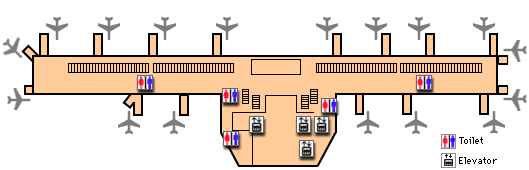
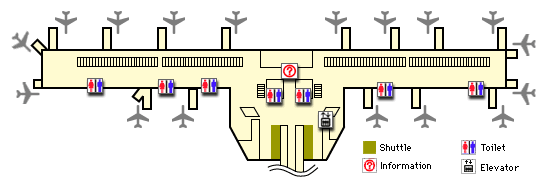
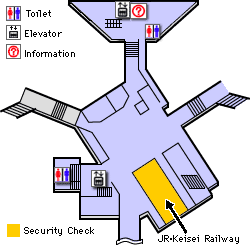
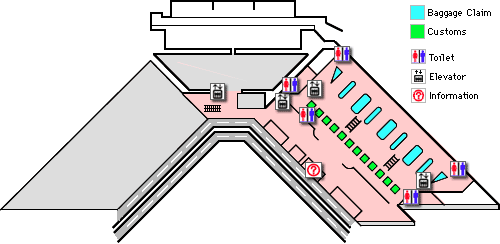
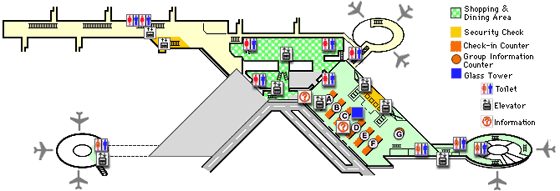
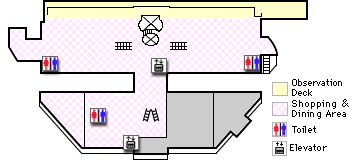
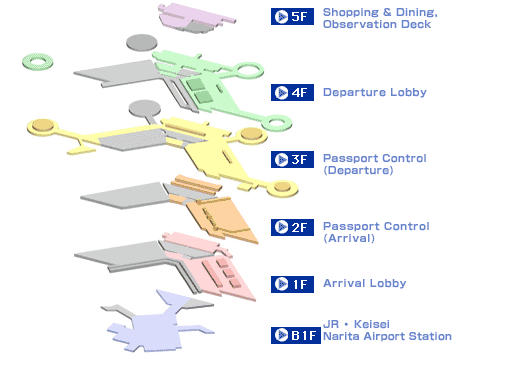
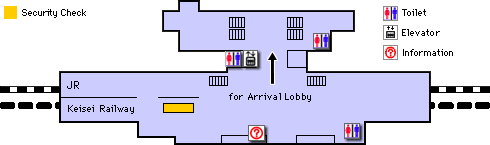
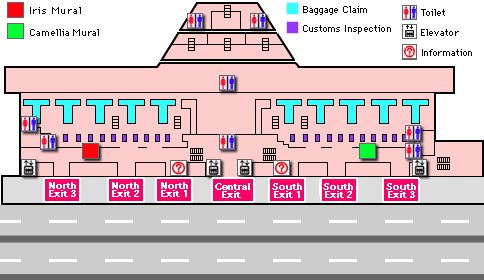
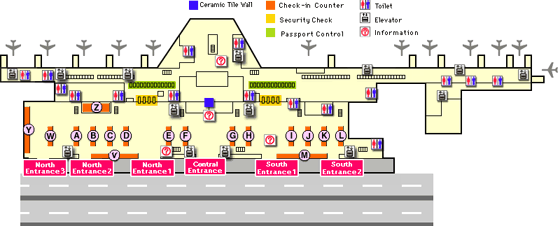
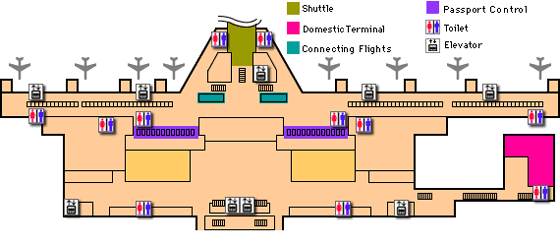
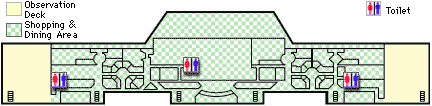
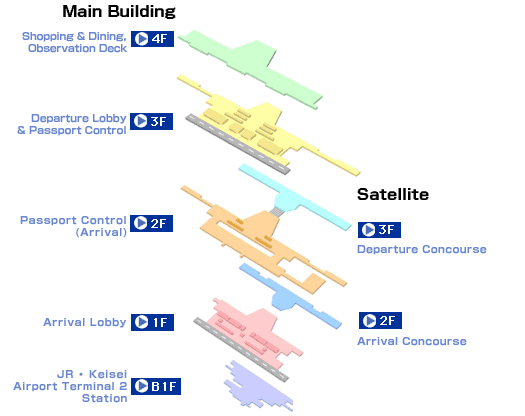
Tokyo, Japan - NRT Airport Map

Tokyo, Japan (NRT) - Airport Parking Information and Parking Search

No Parking information available for this airport

Tokyo Airfares, Japan (NRT) - Airfare Information and Airfare Search

 
Enter details
 
Select your merchants
 
Search & Book
Search Details


Calendar

Calendar


Sign up for our newsletter:
next
 
Merchant Selection
Select up to 4 sites at once!

Updating merchants for your search
 
cheapFlightSales
 
Kayak
 
SideStep
 
Expedia
 
Travelocity
 
Priceline
 
Cheapoair.com
 
OneTravel
 
Orbitz.com
 
Farecast
 
Cheaptickets.com
 
Travelgrove
 
Compare Selected


Attention!
Turn off pop-up blockers
click here for help


Today's Hot Deals Friday, 9/5/08
 
Become a Metafares affiliate via Travelgrove's Affiliate Program!United Sates Great Britain Spain Germany Italy France India 

Cheap Airfares to Tokyo, Japan | Tokyo City Overview | Tokyo Airfare Search | Tokyo City Map | Tokyo NRT Airport | Tokyo City Weather

Cheap domestic flights to:
Orlando Airfares | Las Vegas Airfares | Minneapolis Airfares | Denver Airfares | Los Angeles Airfares | Newark Airfares | Chicago Airfares | Dallas Airfares | New York Airfares | Seattle Airfares | Atlanta Airfares | San Francisco Airfares | Detroit Airfares | Philadelphia Airfares | Boston Airfares
Cheap international flights to:
Frankfurt Airfares | Cancun Airfares | London Airfares | Kharkov Airfares | Tokyo Airfares | Toronto Airfares | Sydney Airfares | Manila Airfares