Singapore Airfares (SIN) - Singapore

Singapore Airfares - Singapore  by metafares
 
cheap airfares hotels car rentals cruises vacations answers travel deals travel blogs 

Singapore, Singapore - City Overview and Airfare Information

Singapore, officially the Republic of Singapore (Malay: 'Republik Singapura'; Chinese: 新加坡共和国, Pinyin: Xīnjiāpō Gnghgu; Tamil: சிங்கப்பூர் குடியரசு, Ciŋkappūr Kudiyarasu), is an island city-state, located at the southern tip of the Malay Peninsula. It lies 137 kilometers (85 miles) north of the Equator, south of the Malaysian state of Johor and north to the Indonesian Riau Islands. It is the smallest country in Southeast Asia.

The site of several ancient port cities, the main island was a fishing village sparsely populated by indigenous Malays and Orang Lauts when it was colonized by the United Kingdom in 1819. Occupied by the Japanese Empire during World War II, it reverted to British rule in 1945 and was later part of the merger which established Malaysia in 1963.

Singapore acquired independence in 1965. Foreign investments and government-led island-wide industrialization has since created an economy relying heavily on electronics and manufacturing exports and entrept and financial trade centering around its strategic port position.

In terms of GDP per capita, Singapore is the 22nd wealthiest country. The geographically small nation has a foreign reserve of S$197b (US$119b).

The Constitution of the Republic of Singapore established the city-state's political system as a representative democracy while the country has official United Nations' recognition of a parliamentary republic. Since its independence, the country has been governed by the People's Action Party, which has won every election to date.

Politics and government

Singapore is a republic with a Westminster system of a unicameral parliamentary government representing different constituencies of Singapore. The bulk of the executive powers rests in the Cabinet, headed by the Prime Minister of Singapore. The office of the President of Singapore, historically a ceremonial one, was granted some veto powers in a few key decisions such as the use of the national reserves and appointment of judiciary positions.[8] The legislative branch of government is the Parliament.

Parliamentary elections in Singapore are plurality-based for group representation constituencies since the Parliamentary Elections Act was modified in 1991.[9]

Singaporean politics have been dominated by the People's Action Party (PAP) since self-government in 1959.[10] Foreign political analysts and several opposition parties like the Workers' Party of Singapore, the Singapore Democratic Party (SDP) and the Singapore Democratic Alliance (SDA) have argued Singapore is essentially a one-party state. Many analysts consider Singapore more an illiberal democracy or procedural democracy than a true democracy. The Economist Intelligence Unit lists Singapore as a country with a 'hybrid' system with democratic and authoritarian elements. Freedom House ranks the country as 'partly free'. Though general elections are free from irregularities and vote rigging, the PAP has been criticised for manipulating the political system through its use of censorship, gerrymandering and civil libel suits against opposition politicians. Political opponents like Francis Seow, J.B. Jeyaretnam and Chee Soon Juan perceive the Singaporean courts as favourable towards the PAP government due to a lack of separation of powers.[11]

Singapore has what its government considers to be a highly successful and transparent market economy. The Housing Development Board oversees a large-scale public housing programme and education in Singapore is a rigorous compulsory public education system. Government-linked companies are dominant in various sectors of the local economy, such as the areas of media, utilities, and public transport. Singapore has consistently been rated as the least-corrupt country in Asia and amongst the top ten cleanest from corruption in the world by Transparency International.[12]

Although Singapore's laws are inherited from British and British Indian laws, including many elements of English common law, the PAP has also consistently rejected liberal democratic values as Western. Laws restricting the freedom of speech are justified by claims that unprohibited speech that may breed disharmony within Singapore's multiracial, multi-religious society.

Some offences can lead to heavy fines or caning and there are laws which allow capital punishment in Singapore for first-degree murder and drug trafficking. Amnesty International has cited Singapore for having 'possibly the highest execution rate in the world' per capita.[13] Male homosexual sex is illegal.

More recently the PAP government has relaxed some of its socially conservative policies and created a 'Feedback Unit'[14] for feedbacks on some policies and public services.

Geography

Singapore is divided into 55 urban planning areas, grouped into 5 regions.

Singapore consists of 63 islands, including the main island itself. There are two connections to Johor — the man-made Johor-Singapore Causeway in the north and Tuas Second Link in the west. Jurong Island, Pulau Tekong, Pulau Ubin and Sentosa are the largest of Singapore's many smaller islands. The highest point of Singapore is Bukit Timah Hill 166 metres, 538 ft).

The urban area used to be only concentrated on the south of Singapore, around the mouth of the Singapore River, and what is now the Downtown Core, while the rest of the land was undeveloped tropical rainforest or used for agriculture. Since the 1960s, the government has constructed new residential towns in outlying areas, resulting in an entirely built-up urban landscape. The Urban Redevelopment Authority is the government agency responsible for the urban planning of Singapore.

Singapore has an on-going land reclamation project with earth obtained from its own hills, the seabed and neighbouring countries. As a result, Singapore's land area grew from 581.5 square kilometres (224.5 sq mi) in the 1960s to 697.2 square kilometres (269.1 sq mi) today, and may grow by another 100 square kilometres (38.6 sq mi) by 2030.[15] Many of the smaller islands have been expanded and joined together through land reclamation in order to form larger, more functional islands, such as in the case of Jurong Island.

Singapore has a tropical rainforest climate with no distinct seasons, under the Kppen climate classification. Its climate is characterised by uniform temperature and pressure, high humidity and abundant rainfall. Temperatures range from 22C to 34 C (72–93F). On average, the relative humidity is around 90% in the morning and 60% in the afternoon. During prolonged heavy rain, relative humidity often reaches 100%.[16] The lowest and highest temperatures recorded in its maritime history are 18.4 C (65.1 F) and 37.8 C (100.0 F) respectively. The highest wind speed recorded is 120 km/h on July 27, 2001 .

About 23% of Singapore's land area consists of forest and nature reserves. Urbanisation has eliminated many areas of former primary rainforest, with the only remaining area of primary rainforest being Bukit Timah Nature Reserve. A variety of parks are maintained with human intervention, such as the Singapore Botanic Gardens. Without natural freshwater rivers and lakes, the primary domestic source of water supply in Singapore is rainfall, collected in reservoirs or catchment areas. Rainfall supplies approximately 50% of Singapore's water; the remainder is imported from Malaysia or obtained from recycled water facilities and desalination plants. More NEWater and desalination plants are being built or proposed to reduce reliance on foreign supply.[17]

Economy

Singapore has a highly developed market-based economy, which historically revolves around extended entrepot trade. The economy depends heavily on exports refining imported goods, especially in manufacturing. Manufacturing constitutes 28% of her GDP in 2005. The manufacturing industry is well-diversified into electronics, petroleum refining, chemicals, mechanical engineering and biomedical sciences manufacturing.

Singapore is the world's fourth largest foreign exchange trading centre after London, New York City and Tokyo.[18]

Singapore has been rated as the most business-friendly economy in the world. [19]

The city-state employs thousands of foreign workers from around the world. Along with Hong Kong, South Korea and Taiwan, Singapore was one of the Four Asian Tigers'.

In 2001, a global recession and slump in the technology sector caused the GDP to contract by 2.2%. The Economic Review Committee (ERC), set up in December 2001, recommended several policy changes with a view to revitalising the economy. Singapore has since recovered from the recession, largely due to improvements in the world economy; the Singaporean economy itself grew by 8.3% in 2004 and 6.4% in 2005.[20]

The per capita GDP in 2005 was US$26,833[21] and the unemployment rate was 2.7% in 2006, with[22] 173,000 new jobs being created in 2006, a record high. The economy grew by 7.9% in 2006.[23]

Singapore introduced a Goods and Services Tax (GST) with an initial rate of 3% on 1 April 1994 substantially increasing government revenue by $1.6 billion and stabilising government finances.[24] The taxable GST was increased to 4% in 2003 and to 5% in 2004.[25] The GST will be further increased to 7% on 1st July 2007.[26]

Singapore is a popular travel destination, making tourism one of its largest industries. About 9.7 million tourists visited Singapore in 2006. The Orchard Road district is the centre of shopping hub in Singapore. To attract more tourists, the government decided in 2005 to legalise gambling and to allow two Integrated Resorts to be developed at Marina South and Sentosa.[27] Other than the Integrated Resort, many other new developments are coming up that includes the Singapore Flyer and Gardens by the Bay.

Cuisine has been heavily promoted as an attraction for tourists, with the Singapore Food Festival in July organized annually to celebrate Singapore's cuisine.

Military

The military of Singapore serves primarily as a deterrent to potential invaders of the island. Singapore has mutual defence pacts with several countries, most notably the Five Power Defence Arrangements. Singapore subscribes to a philosophy of Total Defence, in which five aspects of a holistic national defence are identified. Non-military aspects of total defence include civil defence, which is carried out by the Singapore Civil Defence Force; 'economic defence', which stresses the need for a robust economy in order to maintain a viable society; 'psychological defence', which calls for a patriotic citizenry willing to do all in the name of its country; and 'social defence', in which the need for a population at harmony with itself and strongly identified with each other is emphasised.

The military of Singapore includes the Singapore Army, the Republic of Singapore Navy, and the Republic of Singapore Air Force, collectively known as the Singapore Armed Forces (SAF). Various agencies of the Ministry of Defence (MINDEF) and some private companies also play a supporting role. Singapore employs conscription for all males.

The recent rise in unconventional warfare and terrorism has cast increasing emphasis on the non-military aspects of defence. The Gurkha Contingent, part of the Singapore Police Force, is also a counter-terrorist force. In 1991, the hijacking of Singapore Airlines Flight 117 ended in the storming of the aircraft and the subsequent deaths of all four hijackers. A current concern is Jemaah Islamiyah, a militant Islamic group whose plan to attack the US embassy was ultimately foiled in 2001.

Singapore's defence resources have been used in international humanitarian aid missions, including United Nations peacekeeping assignments in Kosovo, Kuwait and East Timor,[28] and participating in the multinational force in Iraq.[29]

Demographics

Singapore is the second most densely populated independent country in the world, excluding Macau and Hong Kong which are parts of the PRC. The largest ethnic group in the population of 4.48 million (as of June 2006) are the Singaporean Chinese, who account for 76.8% of Singaporeans. The Singaporean Malays, who are the indigenous natives of the country, constitute 13.9%, though this number includes many Malay ethnic groups from other parts of the Malay archipelago including the Javanese, Bugis, Baweans and Minangkabau. Indian Singaporeans are the third largest ethnic group at 7.9%, consisting of several groups — Indian Tamils and Sri Lankan Tamils, who form the largest Indian group, and others such as Malayalees, Punjabis and Bengalis. The rest are made up of smaller groups such as Arab Singaporeans, Jews, Thais, Japanese, European and the Eurasian Singaporean community.[30]

Singapore is also a multi-religious country. More than 40% of Singaporeans practice Buddhism. About 15% practice Christianity (mostly Chinese and Indians), and 15% profess no religion. Muslims (mostly Malays) account for 14%. A smaller minority practices Taoism, Sikhism, Hinduism, Baha'i Faith, and others.

The government of Singapore has been careful to maintain ethnic harmony after racial riots erupted in the 1960s. Racial harmony has been emphasized in all aspects of society, including the Singaporean education system, military and housing. So far the policy has been largely successful, and there have been few signs of ethnic tension since the early 1970s . Current issues include the ban on wearing the Islamic headscarf in public schools.

The national language of Singapore is Malay for historical reasons, and it is used in the national anthem, 'Majulah Singapura'. The official languages are English, Mandarin, Malay and Tamil. English has been promoted as the country's language of administration since independence, and it is spoken by the majority of the population. Public signs and official publications are in English although there are translated versions in the other official languages.

After two decades of a successful family planning policy, Singapore is now facing the threat of an aging population with declining birth rates. The government is encouraging Singaporeans to have more children through the provision of financial incentives for the first to fourth child of each family.[31]

In year 2006, 38,232 babies were born, compared to around 37,600 in 2005. Singapore's large number of migrants has kept Singapore's population from declining.[32]

Architecture

The architecture of Singapore is extremely varied. Due to the lack of available space, few historical buildings remain in the centre of the Central Business District (CBD) of Singapore, known as Raffles Place - the Fullerton Hotel and the previously-moved Lau Pa Sat being some exceptions. However, just outside of Raffles Place, and throughout the rest of the downtown core, there is a large scattering of pre-WWII buildings - some going back nearly as far as Raffles, as with the Empress Place Building, built in 1827. Many beautiful classical buildings were destroyed during the post-war decades, up until the 1990s, when things completely changed and the government started very strict programs to conserve the many remaining buildings and whole areas that are of historic and aesthetic value. Just one example of a partially preserved neighborhood is Chinatown, just abutting Raffles Place. Past the shopping malls are streets lined with old but newly-painted shophouses. Many other such areas have been gazetted as historic districts. Information can be found at the URA Centre. Singapore has also become a centre for modern, or more correctly, postmodern architecture. Historically, the demand for high-end buildings has been in and around the Central Business District (CBD). After decades of development, the CBD has become an area with many tall office buildings. These buildings comprise the skyline along the coast of Marina Bay and Raffles Place, a famous tourist attraction in Singapore. Due to the air restrictions in Singapore, no building in Singapore is to be taller than 280 metres. The three tallest buildings in Singapore, namely Republic Plaza, UOB Plaza One and OUB Centre, are all 280 metres in height.

In addition, some interesting signs of Singapore's colonial past remain in the form of 'Black and White Houses'. These large houses are situated further away from the CBD and were built in the early to mid 19th century. These homes were built to house the British generals and governors when Britain occupied the country. Later, they became home to many Japanese generals after the fall of Singapore during World War II.

Culture

Singapore is a mixture of an indigenous Malay population with a third generation Chinese majority, as well as Indian and Arab immigrants with some intermarriages. There also exist significant Eurasian and Peranakan (known also as 'Straits Chinese') communities. Singapore has also achieved a significant degree of cultural diffusion. One example is in Singaporean cuisine.

The English used is primarily British English, with some American English influences. The local colloquial dialect of English is Singlish, which has many creole-like characteristics, having incorporated vocabulary and grammar from various Chinese dialects, Malay, and Indian languages. Singlish is spoken commonly on the streets, but the government frowns upon its use in official contexts. English became widespread in Singapore after it was implemented as a first language medium in the education system, and English is the most common language in Singaporean literature.

Singapore has several ethnic neighbourhoods, including Little India and Chinatown. These were formed under the Raffles Plan to segregate the immigrants, but now have a more diverse patronage. Many places of worship were also constructed during the colonial era. Sri Mariamman Temple, the Masjid Jamae Mosque and the Church of Gregory the Illuminator are among those that were built during the colonial period. Work is now underway to preserve these religious sites as National Monuments of Singapore.

Since the 1990s, the government has been striving to promote Singapore as a centre for arts and culture, and to transform the country into a cosmopolitan 'gateway between the East and West'.[33] The highlight of these efforts was the construction of Esplanade - Theatres on the Bay, a centre for performing arts that opened on October 12, 2002.[34]

Education

Primary education is compulsory in Singapore since 2000. The literacy rate is one of the highest in Asia, at 95%.[35]

The standard for the school curriculum is set by the Ministry of Education with a mix of private schools and public schools. There is no strict public-private dichotomy: the degree of autonomy regarding curriculum and student admission, government funding received, and tuition burden on the students is further classified into 'government-run', 'government-aided', 'autonomous', 'independent', and 'privately-funded'.[36] In addition, there are international schools catered to expatriate students, which sometimes admit local students.

There have also been complaints about excessive educational streaming at a young age; a popular local film, I Not Stupid, highlights the competitiveness of the system and social stigma that students struggling with studies have to face.

After primary education, students take the Primary School Leaving Examination (PSLE). After secondary education, a further set of examinations are taken which determine which kind of tertiary education they pursue, such as junior college, a precursor for entry into public universities such as National University of Singapore, Nanyang Technological University and Singapore Management University. Other post-secondary institutions include polytechnics, where students will graduate with a diploma. The five existing polytechnics are Temasek Polytechnic, Singapore Polytechnic, Ngee Ann Polytechnic, Nanyang Polytechnic and Republic Polytechnic.

Other institutes include a teaching college to train teachers, various management institutes, and vocational education institutes such as the Institute of Technical Education (ITE).

Singapore students took first place in the 1995, 1999 and 2003 TIMSS Trends in International Mathematics and Science Study. They used Singapore Math Primary Mathematics series. The national textbooks have been adapted into a series which has been successfully marketed in North America as a rival to Saxon math and an alternative to controversial standards-based mathematics curricula.

Transport

Singapore is a major Asian transportation hub, strategically lying on sea and air trade routes. Its history has been closely tied to the growth of its transportation industry since the establishment of its port. The transportation industry comprises over 10% of Singaporean GDP despite an increasingly diversified economy. The Port of Singapore, managed by port operators PSA International and Jurong Port, was the world's busiest port in 2005 in terms of shipping tonnage handled with 1.15 billion gross tons handled, and in terms of containerised traffic, with 23.2 million Twenty-foot equivalent units (TEUs) handled. It was also the world's second busiest in terms of cargo tonnage, coming behind Shanghai with 423 million tons handled. In addition, Singapore is the world's busiest hub for transhipment traffic and the world's biggest ship refuelling hub.[37]

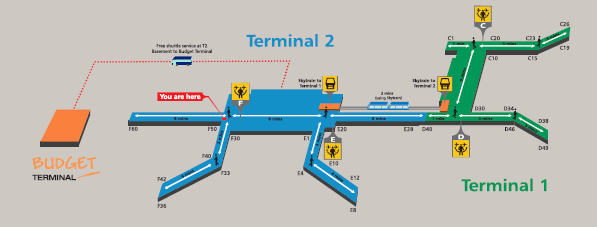
Singapore is an aviation hub, acting as a stopover point for the 'Kangaroo route' between Australasia and Europe. Singapore Changi Airport has a network of 81 airlines connecting Singapore to 179 cities in 57 countries (2005). It is one of the top five airports in Asia in terms of passengers handled, with 30 million passengers passing through in 2004. It has been consistently rated as one of the best international airports by numerous international travel magazines. It was also rated as the world's best airport in 2006 by Skytrax, defeating its long time rival, Hong Kong International Airport.[38] The airport currently has two passenger terminals, Terminal 1 (T1) and Terminal 2 (T2). The Budget Terminal, a low-cost terminal, started operation in March 2006[39]. A third passenger terminal now under construction will increase the airport's total annual capacity to 66.7 million passengers by 2008. The national carrier Singapore Airlines (SIA), which operates from T2, is internationally renowned for its service and will be the first airline in the world to fly the new Airbus A380 commercially.

The backbone of domestic transport infrastructure is the road transport system which includes a network of expressways that form the arteries between distinct towns and regional centres as laid out in Singapore's urban planning. Following a government study assisted by the United Nations Development Programme which foresaw problems with private transport such as traffic congestion and air pollution as the city grew,[40] the Land Transport Authority began a series of measures to develop the use of the public transport system such as improving the nation's bus service and liberalising the hired vehicle market to allow for more taxi operators. Since 1987, the heavy rail passenger Mass Rapid Transit (MRT) metro system has been in operation. MRT was later augmented by and linked to the Light Rapid Transit (LRT) light rail system, which provides service to several expanses of housing estates. The EZ-Link system allows contactless smartcards to serve as stored value tickets for use in the public transport systems. More than 2.8 million people use the bus network daily, while more than 1.3 million people use either the LRT or MRT as part of their daily routine.[41] Approximately 900,000 people use the taxi services daily. Private vehicle use in the Central Area is discouraged by tolls implemented through an Electronic Road Pricing system which operates during hours of heavy road traffic.

International rankings
Economic
  • Doing Business project 2006 @ International Finance Corporation, World Bank, ranked 1 out of 175 economies
  • IMD International: [World Competitiveness Yearbook] [1], ranked 3 out of 60 economies in 2006 (countries and regions)
  • World Economic Forum: Global Competitiveness Report2006-2007 - Growth Competitiveness Index Ranking, ranked 5 out of 124 economies
  • A.T. Kearney/Foreign Policy Magazine: Globalization Index 2005, ranked 1 out of 62 countries
  • Heritage Foundation/The Wall Street Journal: 2007 Index of Economic Freedom, ranked 2 out of 155 countries [2]
  • The Economist: The World in 2005 - Worldwide quality-of-life index, 2005, ranked 11 out of 111 countries
  • Economist Intelligence Unit: 2006 e-readiness rankings, ranked 13 out of 68 economies
  • Transparency International: Bribe Payers Index 2006, ranked 12 out of 30 leading exporting economies
Educational
  • International Association for the Evaluation of Educational Achievement: Trends in International Mathematics and Science Study, ranked 1 out of 46 economies in all four criteria
  • Educational Testing Service: 2003-2004 TOEFL Test Year Data Summary, ranked 4 out of 227 economies
Political
  • Transparency International: Corruption Perceptions Index 2006, ranked 5 out of 163 countries and economies
  • Freedom in the World 2006 ranked Singapore 5 out of 7 for political freedom, and 4 out of 7 for civil liberties (where 1 is the most free), for an overall ranking of 'partly free'.
  • The Economist: The World in 2007 - Index of Democracy, ranked 84 out of 167 countries/territories
Social
  • United Nations Development Programme: Human Development Index 2004, ranked 25 out of 177 countries
  • Reporters Without Borders: Press Freedom Index 2006, ranked 146 out of 168 countries
  • Save the Children: State of the World's Mothers 2004, ranked 16 out of 119 countries (tied with Argentina, Republic of Korea, and Uruguay)
Transportation
  • Skytrax: Worlds Best Airports 2006, Singapore Changi Airport ranked 1 out of 155 airports
  • AAPA: World's busiest container ports, ranked 1
References
  • Diane K. Mauzy & R. S. Milne (2002). Singapore Politics: Under the People's Action Party. Routledge. ISBN 0-415-24653-9. 
  • Census 2000. Singapore Department of Statistics. Retrieved on 11 January, 2000.
  • Key Facts & Figures. Ministry of Transport, Singapore. Retrieved on 11 January, 2003.
  • Nation's History. Singapore Infomap. Retrieved on 11 January, 2004.
  • This article incorporates public domain text from the websites of Singapore Department of Statistics, United States Department of State, the United States Library of Congress & CIA World Factbook (2004).
Notes
  1. ^ Singapore. bartleby.com. Retrieved on 2006-04-14.
  2. ^ Early History. Ministry of Information, Communications and the Arts, Singapore. Retrieved on 2006-04-14.
  3. ^ Singapore - Precolonial Era. U.S. Library of Congress. Retrieved on 2006-06-18.
  4. ^ Founding of Modern Singapore. Ministry of Information, Communications and the Arts, Singapore. Retrieved on 2006-04-14.
  5. ^ Ron Taylor. Fall of Malaya and Singapore. Retrieved on 2006-04-14.
  6. ^ Road to Independence. U.S. Library of Congress. Retrieved on 2006-04-14.
  7. ^ Country profile: Singapore. BBC News. Retrieved on 2006-04-14.
  8. ^ The Presidency in Singapore. Istana website. Retrieved on 2005-01-30.
  9. ^ Parliamentary Elections Act. Singapore Statutes Online. Retrieved on 2006-05-08.
  10. ^ Worthington, Ross (2002). Governance in Singapore. Routledge/Curzon. ISBN 0-7007-1474-X. 
  11. ^ Worldwide Press Freedom Index. Retrieved on 2006-04-13.
  12. ^ Transparency International - Corruption Perceptions Index 2006. Retrieved on 2007-02-03.
  13. ^ Amnesty International. The death penalty: A hidden toll of executions. Retrieved on 7 June, 2005.
  14. ^ Feedback Unit, Singapore
  15. ^ Towards Environmental Sustainability, State of the Environment 2005 Report (PDF). Ministry of the Environment and Water Resources, Singapore. Retrieved on 2006-04-14.
  16. ^ Climate of Singapore. National Environment Agency, Singapore. Retrieved on 2006-04-14.
  17. ^ Clean Water. Ministry of the Environment and Water Resources, Singapore. Retrieved on 2006-04-14.
  18. ^ MAS Annual Report 2005/2006
  19. ^ Singapore is ranked first in the Doing Business Report 2006 by World Bank
  20. ^ Performance of the Singapore Economy in 2005 (PDF), Ministry of Trade and Industry. Retrieved on 2006-04-14.
  21. ^ Per Capita GDP at Current Market Prices. Singapore Department of Statistics (2006-02-16).
  22. ^ May Wong. 'Singapore's employment hits all-time high of 2.3 m in 2005', Channel NewsAsia, 1 February 2006.
  23. ^ Dominique Loh. 'Singapore's economy grows by 7.7% in 2006', Channel NewsAsia, 31 December 2006.
  24. ^ FY 1996 Budget, Revenue And Tax Changes. Retrieved on 2006-05-01.
  25. ^ Policy Digest: Phased GST increase (December 21, 2002). Retrieved on 2006-04-26.
  26. ^ GST rate to rise to 7% from July 1. Retrieved on 2007-02-15.
  27. ^ Proposal to develop Integrated Resorts - Ministerial Statement by Prime Minister Lee Hsien Loong on 18 April 2005.
  28. ^ Peacekeepers :: In the Service of Peace. Retrieved on 2006-05-01.
  29. ^ 'Singapore to send 192 military personnel to Iraq', Agence France Presse, October 27, 2003.
  30. ^ Key Indicators of Resident Population by Ethnic Group. Singapore Department of Statistics.
  31. ^ Baby Bonus. Ministry of Community Development, Youth and Sports. Retrieved on 2006-04-14.
  32. ^ Singapore's birth trend outlook remains dismal. Channel News Asia..
  33. ^ Renaissance City Report: Culture and the Arts in Renaissance Singapore (Ministry of Information, Communications and the Arts). Retrieved on 2006-05-01.
  34. ^ Virtual Tourist: Reviews of Esplanade (Theatres by the Bay). Retrieved on 2006-03-28.
  35. ^ Singapore in Brief 2006, Singapore Department of Statistics (PDF). Retrieved on 2006-05-01.
  36. ^ Education System:Secondary. Retrieved on 2006-05-01.
  37. ^ 'Singapore remains world's busiest port', Xinhuanet, 12 January 2006.
  38. ^ 2006 Airport of the Year result. Retrieved on 2006-06-01.
  39. ^ 'Singapore opens budget air terminal', Channel NewsAsia, 26 March 2006.
  40. ^ Tien Fang Fwa (4 September 2004). 'Sustainable Urban Transportation Planning and Development — Issues and Challenges for Singapore'. University of Tokyo. Retrieved on 2006-05-01.
  41. ^

Singapore, Singapore City Weather

We have not found any weather information for the selected city.

Singapore, Singapore - SIN Airport Map

Singapore, Singapore - Singapore Changi (SIN) Airport Information and Airport Layout

Terminal    


Terminal

Singapore, Singapore (SIN) - Airport Parking Information and Parking Search

No Parking information available for this airport

Singapore Airfares, Singapore (SIN) - Airfare Information and Airfare Search

 
Enter details
 
Select your merchants
 
Search & Book
Search Details


Calendar

Calendar


Sign up for our newsletter:
next
 
Merchant Selection
Select up to 4 sites at once!

Updating merchants for your search
 
cheapFlightSales
 
Kayak
 
SideStep
 
Expedia
 
Travelocity
 
Priceline
 
Cheapoair.com
 
OneTravel
 
Orbitz.com
 
Farecast
 
Cheaptickets.com
 
Travelgrove
 
Compare Selected


Attention!
Turn off pop-up blockers
click here for help


Today's Hot Deals Friday, 9/5/08
 
Become a Metafares affiliate via Travelgrove's Affiliate Program!United Sates Great Britain Spain Germany Italy France India 

Cheap Airfares to Singapore, Singapore | Singapore City Overview | Singapore Airfare Search | Singapore City Map | Singapore SIN Airport | Singapore City Weather

Cheap domestic flights to:
Atlanta Airfares | Chicago Airfares | San Francisco Airfares | Seattle Airfares | Dallas Airfares | New York Airfares | Orlando Airfares | Denver Airfares | Boston Airfares | Minneapolis Airfares | Baltimore Airfares | Las Vegas Airfares | Fort Lauderdale Airfares | Newark Airfares | Detroit Airfares
Cheap international flights to:
Frankfurt Airfares | Cancun Airfares | Toronto Airfares | Tokyo Airfares | Sydney Airfares | San Juan Airfares | Paris Airfares | Bangkok Airfares