Baltimore Airfares (BWI) - Maryland

Baltimore Airfares - Maryland  by metafares
 
cheap airfares hotels car rentals cruises vacations answers travel deals travel blogs 

Baltimore, Maryland - City Overview and Airfare Information

Baltimore is an independent city located in the state of Maryland in the United States of America. As of 2005, the population of Baltimore City was 641,943 and the Baltimore-Towson metropolitan area (MSA) had approximately 2.6 million residents. Baltimore is also part of the even bigger Baltimore-Washington Metropolitan Area (CMSA) of approximately 8.1 million residents. Baltimore is the largest city in Maryland and the fourth largest city on the East Coast, after New York City, Philadelphia and Jacksonville; its metropolitan area is the 19th largest in the country.

The city is named after the founding proprietor of the Maryland Colony, Lord Baltimore in the Irish House of Lords. Baltimore became the second leading port of entry for immigrants to the United States during the 1800s. The city is a major U.S. seaport, situated closer to major Midwestern markets than any other major seaport on the East Coast.

Because there is also a Baltimore County surrounding (but not including) the city, it is sometimes referred to as Baltimore City when a clear distinction is desired.

People from Baltimore are known as Baltimoreans.

Law and government

Baltimore is an independent city — not part of any county. For most governmental purposes under Maryland law, Baltimore City is treated as a 'county'-level entity. The United States Census Bureau uses counties as the basic unit for presentation of statistical information in the United States, and treats Baltimore as a county equivalent for those purposes.

Baltimore has been a Democratic stronghold for over 150 years, with Democrats dominating every level of government.

Mayor
For a full list of mayors that served the city, see List of Baltimore Mayors.

In November of 2006, Martin O'Malley, who had been mayor since 1999, was elected Governor of Maryland. He took office on January 17, 2007. Per the city's charter, City Council President Sheila Dixon, will finish out the last year of O'Malley's second term. Dixon says that she intends to run for a full term in the 2007 election, but many other prominent city political figures are also interested in entering the race [1].

Baltimore City Council

Grassroots pressure for reform, voiced as Question P, restructured the city council in November of 2002, against the will of the mayor, the council president, and the majority of the council. A coalition of union and community groups, organized by ACORN, backed the effort.

The Baltimore City Council is now made up of 14 single member districts and one elected at-large council president. Stephanie Rawlings Blake is the council's president and Robert W. Curran is the Vice President.

State Government

Prior to 1969 some considered Baltimore and its suburbs to be particularly underrepresented in the Maryland General Assembly, while rural areas were heavily overrepresented. Since Baker v. Carr in 1969, Baltimore and its suburbs account for a substantial majority of seats in the state legislature; this has caused some to argue that rural areas are now underrepresented.

Baltimore dominated Maryland state politics prior to 1969, however; even today, most of the state's highest elected officials come from the Baltimore area.

Federal Government

Three of the state's eight congressional districts include portions of Baltimore--the 2nd, represented by Dutch Ruppersberger; the 3rd, represented by John Sarbanes; and the 7th, represented by Elijah Cummings. All three are Democrats; a Republican has not represented a significant portion of Baltimore in decades, and has not represented any of Baltimore since 2003.

Both of Maryland's Senators, Ben Cardin and Barbara Mikulski, are from Baltimore. Ironically, both represented the 3rd District before being elected to the Senate. Mikulski represented the 3rd from 1977 to 1987, and was succeeded by Cardin, who held the seat until his election and inauguration to the Senate in 2007.

Crime

City Crime Rankings (12th Edition) ranks Baltimore second only to Detroit among the most dangerous American cities over 500,000 in population.[9] According to crime statistics there were 269 homicides in Baltimore in 2005,[10] giving it the highest homicide rate per 100,000 of all U.S. cities of 250,000 or more population. [2] Though this is significantly lower than the record-high 353 homicides in 1993, the homicide rate in Baltimore is nearly seven times the national rate, six times the rate of New York City, and three times the rate of Los Angeles. In addition, other categories of crime in Baltimore have also been declining, although overall crime rates are still high compared to the national average. The rate of forcible rapes has fallen below the national average in recent years; however, Baltimore still has much higher-than-average rates of aggravated assault, burglary, robbery, and theft[11] and a local news survey, though unscientific, recorded that over 75% of respondents felt that Baltimore City is no safer.[12]

Though the crime situation in Baltimore is considered one of the worst in the nation, city officials have pointed out that most violent crimes, particularly homicides, are committed by people who know their victims and who are often associated with the illegal drug trade.[13]

City officials have, however, come under scrutiny from Maryland legislators regarding the veracity of crime statistics reported by the Baltimore City Police Department.[14] For 2003 the FBI identified irregularities in the number of rapes reported, which was confirmed by the Mayor. 2005's homicide numbers appeared to exhibit discrepancies as well[15] The former Commissioner of Police stated upon interview that the administration suppressed corrections of its reported crime.[16] However, many of these charges seem to be, at least partially, politically motivated.[17] Nonetheless, experts indicate that the city's reporting practices merit an independent audit, with which the administration has not cooperated, despite requests from members of City Council and the City's auditor.[18] While racial disparities in arrest and incarceration rates exist in Baltimore, both young white and black men in the city are arrested and incarcerated at relatively high rates. Fifty-two percent of black males in their 20s are either in prison, in jail, or under correctional supervision.[19]

At the same time however, a largely African American police force and correctional officer staff is present. Currently the department is administered by Commissioner Leonard D. Hamm, and Deputy Commissioners Marcus L. Brown and Errol L. Dutton, all three of whom are African American. During Martin O'Malley's administration as mayor, the department had become 43% African American. [20] While the arrest and incarceration rates are disproportionate and subject to criticism, its harder to accuse a department with a large African American presence of racism.

The ACLU has filed a suit in respect of systematic civil rights abuses by the current administration.[21]

Criminal intimidation has also been reported as a problem in the city.[22] In an infamous case, community activist Angela Dawson and her family were murdered by firebomb in their Baltimore home on October 16, 2002, in retaliation for Dawson's reporting of criminal activity. In a separate incident, another public safety activist, Edna McAbier, was also targeted.[23] Though she survived, she has fled her neighborhood, where she cannot be protected by city police.[24] In 2005, 3 men were sentenced to life in prison for their involvement in the latter case.[25] One of these men had appeared in the infamous video Stop Snitchin', a homemade DVD produced by local drug dealers threatening fellow dealers who failed to adhere to a street based code of ethics and became informants.

Culture

Despite the city's fame for its high crime rate (a reputation arguably fanned by such Baltimore-based TV series as Homicide: Life on the Street, The Corner, and The Wire), Baltimore nevertheless retains a distinctive local culture and social flavor. Historically a working-class port town, Baltimore has sometimes been dubbed a 'city of neighborhoods,' with different districts traditionally occupied by distinct ethnic groups. Most notable today are three downtown areas along the port: the Inner Harbor, frequented by tourists due to its hotels, shops, and museums; Fells Point, once a favorite entertainment spot for sailors but now refurbished and gentrified (and featured in the movie Sleepless in Seattle); and Little Italy, located between the other two, where Baltimore's Italian community was based–and where current U.S. House Speaker Nancy Pelosi grew up. Further inland, Mt. Vernon is the traditional center of cultural and artistic life of the city; it is home to a distinctive Washington Monument, set atop a hill in a 19th century urban square, that predates the monument in Washington, D.C. by several decades.

The traditional local accent has long been noted and celebrated as 'Baltimorese' or 'Bawlmorese.' One thing outsiders quickly notice is that the locals refer to their city as 'Bawlmer' or 'Ballmer,' dropping with the 't' for the most part. The dialect is similar to that of most Marylanders and many Pennsylvanians; it may reflect the region's roots in Cornwall and the English West Country, as many of the original settlers of the Chesapeake Bay area came from this area in colonial times. (Traditionally, Marylanders call their state 'Merlin'--and likewise, many Pennsylvanians call their state 'Pennsavania,' dropping the 'l'.) However, Baltimore's local accent also reflects the rich mix of ethnic groups from Ireland, Germany, and southern and eastern Europe who immigrated to the city during the industrial era. (For a more in-depth discussion of the Maryland dialect, click the 'Culture of Baltimore' link above.)

As Baltimore's demographics have changed since World War Two, its cultural flavor and accents have evolved as well. Today, after decades of out-migration to suburbs beyond its corporate limits and significant in-migration of African-Americans from Georgia and the Carolinas, Baltimore has become a majority African-American city with a significantly changed, but still regionally distinctive, dialect and culture. In addition, new immigrants from Latin America are making their mark, notably in neighborhoods near Fells Point.

Much of Baltimore's African-American culture has roots that long predate the 20th-century 'Great Migration' from the Deep South. Like Atlanta, Georgia and Washington, D.C., Baltimore has been home to a successful southern African-American middle class and professional community for centuries. Before the Civil War, Baltimore had one of the largest concentrations of free African-Americans among American cities. In the twentieth century, Baltimore-born Thurgood Marshall became the first African-American justice of the U.S. Supreme Court. Baltimore's culture has been famously celebrated in the movies of Barry Levinson, who grew up in the city's Jewish neighborhoods. His movies Diner, Tin Men, Avalon, and Liberty Heights are inspired to varying degrees on his life in the city.

Night Life

Baltimore has a thriving night life for many different types of people. The Federal Hill, Canton and Fells Point neighborhoods have numerous bars and pubs which serve as popular places for young professionals and college students to gather on Friday and Saturday nights. The majority of the bars and nightclubs in Baltimore have a relaxed dress code and moderately priced drinks in comparison to other major cities. The Mount Vernon area has bars which target the gay community, and there are establishments which support the Baltimore Club scene located in proximity to M&T Bank Stadium. Power Plant Live! is also home to a variety of bars, dance clubs and restaurants as well. For those who are interested in a racier after-hours scene, The Block contains a wide range of Adult Entertainment venues.

Architecture

Baltimore possesses samples from every period of architecture for over two centuries, and work from many famous architects such as Benjamin Latrobe, John Russell Pope, Mies Van Der Rohe and I.M. Pei.

The city has architecturally important buildings in a variety of styles. The Baltimore Basilica(1806-1821) is a classical design by Benjamin Latrobe and also the oldest Catholic Cathedral in the United States. The Phoenix Shot Tower (1828) was the tallest building in the United States until the time of the Civil war at 215 feet tall. It was constructed without the use of scaffolding. I.M.Pei's World Trade Center[3] (1977) is the tallest equilateral pentagonal building in the world at 405 feet tall.

The most recognizable figure in the city's skyline is the art deco design of the Bank of America Building (1924) [[4]]. It was the tallest skyscraper in the city at 509 feet tall until 1973 when the Legg Mason Building was completed at a height of 529 feet. The eight-sided Charles Center Office Tower[5] is Mies Van Der Rohe's only design in the city of Baltimore.

Future contributions to Baltimore's skyline include plans for a 717 foot tall structure known as '10 Inner Harbor'. The building was recently approved by Baltimore's design panel and will be completed around the year 2010. It will include luxury condominiums, a hotel, restaurants, and shopping centers.

The streets of Baltimore are organized in a grid pattern. The streets are lined with tens of thousands of brick faced rowhouses. Many consider the rowhouse the architectural form most closely associated to the city. Some rowhouses are dated as far back as the 1790's.

Oriole Park at Camden Yards is considered by many to be the most beautiful ball park in Major League Baseball, and has inspired many other cities to build their own versions of this Retro-Style Ballpark.

Camden Yards along with the National Aquarium have helped revive the Inner Harbor from what once was an Industrial zone full of dilapidated warehouses, into a bustling commercial district full of bars, restaurants and retail establishments.

Geography and climate Geography

Baltimore is in the north central part of the state of Maryland, on the Patapsco River, not far from the Chesapeake Bay. It is on the western edge of the Atlantic Coastal Plain, with low hills rising on the western edge of the city. Baltimore's City Hall lies approximately 34 feet above sea level, with elevations in the city ranging from 10 feet to over 100 feet at the western fringe. According to the United States Census Bureau, the city has a total area of 238.5 km² (92.1 mi²). 209.3 km² (80.8 mi²) of it is land and 29.2 km² (11.3 mi²) of it is water. The total area is 12.240 percent water.

The Baltimore-Washington Metropolitan Area is the 4th largest Combined Statistical Area in the United States, with an estimated population of 8,052,496. The Baltimore-Towson Metropolitan Statistical Area is the 19th largest MSA, with a population of 2,655,675.

Neighborhoods
Climate

Baltimore has a humid subtropical climate, according to the Köppen classification, with moderating influence from its relative proximity to the ocean. It gets relatively hot, humid summers and cool, moist winters, but the seasons are less extreme than that of other American cities farther inland at a similar latitude, such as Denver, CO and Kansas City, MO.

July is typically the hottest month of the year, with an average high temperature of 91°F (33°C) and an average low of 73°F (23°C). Summer is also a season of very high humidity in the Baltimore area, with frequent afternoon thunderstorms occurring regularly. The record high for Baltimore is 108°F (42°C), set in 1985. January is the coldest month, with an average high of 44°F (7°C) and an average low of 29°F (-2°C). However, winter warm fronts can bring brief periods of springlike weather, and arctic fronts can briefly drop nighttime low temperatures into the teens. The record low temperature for Baltimore is -7°F (-22°C), set in 1934. Baltimore rarely experiences temperatures below 10°F or above 105°F. Due to an urban heat island effect in the city proper and a moderating effect of the Chesapeake Bay, the outlying, inland, and higher elevation parts of the Baltimore metro area are usually several degrees cooler in winter and hotter in summer than the city proper and the coastal towns.

Typical in most East Coast cities, precipitation is generous, and very evenly spread throughout the year, with every month bringing 3-4 inches of precipitation, averaging around 43 inches annually. Spring, summer, and fall bring frequent showers and thunderstorms, with an average of 105 sunny days a year. Annual snowfall averages around 18 inches (46 cm). However, seasonal snow totals have ranged from less than an inch to over 60 inches. [26] In the northern and western suburbs, the climate begins to transition to a continental, and thus snowfall amounts are usually higher, and winter low temperatures lower, with some towns annually receiving 24-36 inches (61-91 cm). [27] Because winter daytime temperatures often hang just above the freezing point in Baltimore city, freezing rain is not uncommon, although major ice storms are rare.

The city lies in between two peculiar physical features that protect it from extreme weather and account for the relatively tempered seasons. The Appalachian Mountains protect central Maryland from much of the harsh northern winds and accompanying lake effect weather that bring subfreezing temperatures and heavy snows to the Great Lakes region, and the Delmarva Peninsula protects Baltimore from many of the tropical storms that affect the immediate coast.

Average Monthly Temperatures and Precipitation for Baltimore, MD
Transportation Road transport

The major highways serving the city are I-695 (the Baltimore Beltway), I-95, I-83 (the Jones Falls Expressway), and I-70 (the eastern terminus of which is just beyond the city limits). Freeways I-95, I-83, and I-70 are not directly connected to each other because of freeway revolts in the City of Baltimore led by Barbara Mikulski, which resulted in the abandonment of the original plan. There are two tunnels traversing the Baltimore harbor within the city limits: the four-bore Fort McHenry Tunnel (served by I-95) and the two-bore Harbor Tunnel (served by I-895).

Passenger rail

Baltimore is a major stop for Amtrak. Named passenger trains which serve Baltimore include Acela Express, Palmetto, Carolinian, Silver Star, Silver Meteor, Vermonter, Crescent, and Amtrak's Regional trains.

Public transit

Public transit in Baltimore City is provided by the Maryland Transit Administration. Baltimore City has a bus system, a light rail system, and a subway line. Additionally, MARC commuter rail connects Washington, D.C.'s Union Station with the city's two main intercity rail stations, Camden Station and Penn Station. A new rapid bus service, known as the no. 40 line, connects the Social Security/Woodlawn area and eastern suburbs with the downtown area. In recent months there has been serious consideration to extending both Baltimore's light rail and subway lines. A proposed Red Line would link the Social Security Administration to Fells Point and possibly out to the Dundalk/Essex communities. Other possible commuter rail routes are being considered.

Airports
  • Baltimore-Washington International Thurgood Marshall Airport - in neighboring Anne Arundel County
  • Martin State Airport - (general aviation) - in Baltimore County
Demographics

After New York City, Baltimore was the second city in the United States to reach a population of 100,000, (followed by New Orleans, Philadelphia, Boston).[28] Baltimore was the second largest city in the nation until 1860, when it was surpassed by Philadelphia. Baltimore remained one of the 10 largest cities in the United States from 1790 until about 1970. The city and metropolitan area currently rank in the top 20 in terms of population.

In the 1830, 1840, and 1850 censuses of the United States of America, Baltimore was the second-largest city in population. It was among the top 10 cities in population in the United States in every census up to the 1980 census. Recently, a 2005 census estimate projected that Baltimore was the city with the largest population drop alongside Detroit and Washington D.C., losing over 84,000 residents between 1990 and 2000.[29]

As of 2005, the population was 641,943, down slightly from 643,304 in 2004, but higher than the century-long low of 636,251 in 2000. The Baltimore–Towson metropolitan area, as of 2004, was estimated to have a population of 2.6 million.[30] The population density was 3,111.5/km² (8,058.4/mi²). There were 300,477 housing units at an average density of 1,435.8/km² (3,718.6/mi²). The racial makeup of the city was 64.34% Black or African American, 31.63% White, 0.32% Native American, 1.53% Asian, 0.03% Pacific Islander, 0.67% from other races, and 1.47% from two or more races. 1.70% of the population were Hispanic or Latino of any race. This census however does not accurately represent the city's Latino population however which over the past few years has been steadily increasing. This growth is mainly seen in the southeastern neighborhoods around Fells Point, Patterson Park, and Highlandtown and in the city's Northwestern neighborhoods such as Fallstaff, and various neighborhoods of Northeastern Baltimore.

There were 257,996 households out of which 25.5% had children under the age of 18 living with them, 26.7% were married couples living together, 25.0% had a female householder with no husband present, and 43.0% were non-families. 34.9% of all households are made up of individuals, and 11.3% had someone living alone who was 65 years of age or older. The average household size was 2.42, and the average family size was 3.16.

In the city the population was spread out with 24.8% under the age of 18, 10.9% from 18 to 24, 29.9% from 25 to 44, 21.2% from 45 to 64, and 13.2% who were 65 years of age or older. The median age was 35 years. For every 100 females there were 87.4 males. For every 100 females age 18 and over, there were 82.9 males.

The median income for a household in the city was $30,078, and the median income for a family was $35,438. Males had a median income of $31,767 versus $26,832 for females. The per capita income for the city was $16,978. About 18.8% of families and 22.9% of the population were below the poverty line, including 30.6% of those under age 18 and 18.0% of those age 65 or over.

Economy

Once an industrial town, with an economic base focused on steel processing, shipping, auto manufacturing, and transportation, Baltimore is now a modern service economy. Although deindustrialization took its toll on the city, costing residents many low-skill, high-wage jobs, the city is a growing financial, business, and health service base for the southern Mid-Atlantic region. The city is home to only one Fortune 500 Company, Constellation Energy, and its suburbs are home to two more--Grace Chemicals, in Columbia, and Black & Decker in Towson. However, many other companies call Baltimore home, including asset manager Legg Mason, investment advisories T. Rowe Price and Brown Advisory, Alex. Brown, a subsidiary of Deutsche Bank (of Baltimore origin, and at the time of its acquisition, the oldest continuously-running investment bank in the United States), FTI Consulting, Vertis, Thomson Prometric, Performax, Sylvan Learning/Laureate Education, Under Armour, 180º, Old Mutual Financial Network, and Advertising.com. The city is also home to the Johns Hopkins Hospital, which will serve as the center of a new biotechnology park. The park, one of two such projects currently under construction in the city, will provide room for medical/technology upstarts as well as industry giants to tap into the wealth of knowledge in Baltimore. Baltimore is widely regarded as one of the world's most important depositories of medical knowledge.

Education Colleges and universities

Baltimore is the home of several places of higher learning, both public and private. Among them are:

Private

  • Baltimore Hebrew University (BHU)
  • Baltimore International College (BIC)
  • College of Notre Dame of Maryland (CND or NDM)
  • Johns Hopkins University (JHU)
  • Loyola College in Maryland
  • Maryland Institute College of Art (MICA)
  • Peabody Institute
  • Sojourner-Douglass College

Public

  • Baltimore City Community College (BCCC)
  • Coppin State University
  • Morgan State University
  • University of Baltimore (UB)
  • University of Maryland, Baltimore (UMB, formerly UMAB)

As well as those located within the city, several are located in the suburbs that surround the city. Major ones include:

  • Goucher College, in Towson (private)
  • Towson University, in Towson (public)
  • University of Maryland Baltimore County (UMBC), in Catonsville (public)
  • Villa Julie College, in Stevenson and Owings Mills (private)
  • Ner Israel Rabbinical College in Pikesville (private)
Primary and secondary schools

The city's public schools are operated by the Baltimore City Public School System, which includes Baltimore City College—the third oldest public high school in the country—and Baltimore Polytechnic Institute.

Private schools

  • Boys' Latin School of Maryland
  • Gilman School
  • Roland Park Country School
  • Friends School of Baltimore
  • The Bryn Mawr School
  • Institute of Notre Dame
  • Waldorf School of Baltimore
  • Baltimore Jr. Academy
  • Calvert School
  • Archbishop Curley

Some private schools are located in the nearby suburbs

  • The Park School
  • St. Paul's School
  • St. Paul's School for Girls
  • McDonogh School
  • Garrison Forest School
  • Oldfields School
  • Ruxton Counry Day school

Parochial schools

  • Archbishop Curley High School
  • Archbishop Spalding High School
  • Bais Yaakov High School
  • Beth Tfiloh
  • B'nos Yisroel D'Baltimore
  • Calvert Hall College High School
  • The Cardinal Gibbons School
  • Catholic High School of Baltimore
  • St. Frances Academy
  • Institute of Notre Dame
  • Israel Henry Beren High School part of Ner Israel
  • Loyola Blakefield
  • Maryvale Preparatory School
  • Mercy High School
  • Mount de Sales Academy
  • Mount Saint Joseph High School
  • Notre Dame Preparatory School
  • Seton Keough High School
  • Towson Catholic High School
  • Yeshivas Chofetz Chaim D'Baltimore (Talmudical Academy)
  • Yeshivat Rambam
Media

Although Baltimore is only 45 minutes north of Washington by automobile, it is a major media market in its own right. Its main newspaper, The Baltimore Sun, was sold by its Baltimore owners in 1988 to the Times Mirror Company, which has since been bought by Tribune Company. Baltimore is the 24th-largest television market and 21st-largest radio market in the country.

Newspapers Television
  • WBAL-TV (NBC)
  • WBFF (FOX)
  • WJZ-TV (CBS)
  • WMAR (ABC)
  • WNUV (The CW)
  • WUTB (MyNetworkTV)
  • Public Access, Channel 75
  • Education, Channel 76
  • Government, Channel 25
Radio Museums and attractions Sports teams
  • Baltimore Orioles - (Major League Baseball)
  • Baltimore Ravens - (National Football League)
  • Baltimore Blast - (Major Indoor Soccer League)
  • Crystal Palace F.C. USA - (USL Second Division)
  • Baltimore Blackbirds - (American Indoor Football Association)
  • Baltimore Burn - (National Women's Football Association)
Defunct (or moved) sports teams

Baseball

  • Baltimore Unions - (Union Association)
  • Baltimore Terrapins - (Federal League)

Football

  • Early County Bobcats- (High School League)
  • Baltimore Stallions - (Canadian Football League)
  • Baltimore Stars - (United States Football League)
  • Baltimore Colts - (National Football League 1953-83)
  • Baltimore Colts - (All-America Football Conference/NFL 1947-50)

Basketball

  • Baltimore Bullets (1947-1955) - (National Basketball Association)
  • Baltimore Bullets (1963-1972) - (National Basketball Association)
  • Baltimore Claws - (American Basketball Association)
  • Baltimore Lightning - (Continental Basketball Association) in 1985 - 86. Played games at Towson Center at Towson University.
  • Baltimore Bayrunners - (International Basketball League)
  • Baltimore Pearls - (American Basketball Association)

Soccer

  • Baltimore Bays - (North American Soccer League)
  • Baltimore Blast - (Major Soccer League) (1980-1992)
  • Baltimore Comets - (North American Soccer League)

Hockey

  • Baltimore Blades - (World Hockey Association)
  • Baltimore Bandits - (American Hockey League)
  • Baltimore Clippers - (American Hockey League, Eastern Hockey League, Southern Hockey League)
  • Baltimore Skipjacks - (American Hockey League, Atlantic Coast Hockey League)

Lacrosse

  • Baltimore Tribe (1988) - American Lacrosse League - played for the 4 weeks the league existed and then folded with the league. Played at University of Maryland-Baltimore County in Catonsville.
  • Baltimore Thunder (1987–1999) - National Lacrosse League - moved to Pittsburgh, then Washington, D.C.; now Colorado.
  • Baltimore Bayhawks (2001–2006) - Major League Lacrosse - moved to Washington, D.C.
Orchestras
  • Baltimore Symphony Orchestra
  • Greater Baltimore Youth Orchestra
Sister cities

Baltimore has eleven sister cities, as designated by Sister Cities International, Inc. (SCI):

  • Alexandria, Egypt
  • Ashkelon, Israel
  • Cadiz, Spain
  • Gbarnga, Liberia
  • Genoa, Italy
  • Kawasaki, Japan
  • Luxor, Egypt
  • Odessa, Ukraine
  • Pireaus, Greece
  • Rotterdam, Netherlands
  • Xiamen, China


Baltimore in fiction

See main article Baltimore in Fiction for more information.

References
  1. ^ Connery, William. 'Maryland’s Mob Town Supplied Links Through Rail and Fort'. May 2002. URL retrieved on January 27, 2007.
  2. ^ Smith, Van. 'Mob Rules'. Baltimore City Paper. October 6, 2004. URL retrieved on January 27, 2007.
  3. ^ O'Mara, Richard. 'Backstory: Baltimore - 'Home of 1,000 Slogans''. The Christian Science Monitor. January 5, 2006. URL retrieved on January 27, 2007.
  4. ^ Get in on it. Baltimore Area Convention and Visitors Association (BACVA). URL retrieved on January 27, 2007.
  5. ^ 'The Chesapeake Campaign'. Pride of Baltimore II. Baltimore Clipper History. URL retrieved on January 27, 2007.
  6. ^ Fritze, John. 'Dixon Takes Oath'. The Baltimore Sun. January 19, 2007. URL retrieved on January 20, 2007.
  7. ^ 'Baltimore City Transition 2007 Explained', Baltimore City Council website. URL retrieved on January 20, 2007.
  8. ^ Baltimore City, Mayor - D Primary, Our Campaigns. URL retrieved on January 20, 2007.
  9. ^ Morgan Quitno's America's Safest Cities, 'City Crime Rankings by Population Group'.
  10. ^ Anna Ditkoff, 'Murder Ink'., Baltimore City Paper (January 11, 2006)
  11. ^ 'Baltimore Maryland Crime Statistics and Data Resources'., AreaConnect
  12. ^ 'Is Baltimore getting safer?'., WBAL-TV
  13. ^ 'Promising Strategies To Reduce Gun Violence'., Office of Juvenile Justice and Delinquency Prevention (1998)
  14. ^ 'State Lawmaker Calls For Investigation Into Police'., WBAL-TV (February 14, 2006)
  15. ^ 'Homicide Rate, Police Procedures Questioned'., WBAL-TV (February 14, 2006)
  16. ^ 'Ex-Commish Raised Questions During Tenure'., WBAL-TV (February 22, 2006)
  17. ^ John Wagner and Tim Craig, 'Duncan Rebukes O'Malley Over Crime'., Washington Post (February 14, 2006)
  18. ^ 'Criminologists Express Doubt About O'Malley's Crime Statistics'., The Associated Press (February 12, 2006)
  19. ^ Ryan Davis, 'Study: 1 in 5 young black city men in jail'., The Baltimore Sun (March 16, 2005)
  20. ^ {{[[cite web | title='Black police officers claim discrimination within Baltimore department' | url=http://seattletimes.nwsource.com/html/nationworld/2002111604_webbaltimore07}}, The Seattle Times (December 7, 2006)
  21. ^ 'ACLU, NAACP Sue Baltimore Over Illegal Arrests'., The Associated Press (June 15, 2006)
  22. ^ Gary Gately, 'Baltimore struggles to battle witness intimidation'., The Boston Globe (February 12, 2005)
  23. ^ Matthew Dolan, 'Victim describes fire attack'., The Baltimore Sun (December 6, 2005)
  24. ^ Matthew Dolan, 'A life exiled'., The Baltimore Sun (September 19, 2006)
  25. ^ Matthew Dolan, '3 convicted in firebombing case'., The Baltimore Sun (December 14, 2005)
  26. ^ NOAA, 'Baltimore Average Monthly Snowfall (since 1883)'.
  27. ^ NOAA, 'Maryland Average Annual Snowfall Map'.
  28. ^ United States census data for 1830, 1840, and 1850
  29. ^ 'Top 50 Cities in the U.S. by Population and Rank (2005 Census)'. infoplease.com. 2005. Retrieved August 1, 2006
  30. ^ Annual Estimates of the Population of Metropolitan and Micropolitan Statistical Areas: April 1, 2000 to July 1, 2004 (CBSA-EST2004-01)

Baltimore, Maryland City Weather

Current conditions: Partly Cloudy

Partly Cloudy
82 °F
28 °C

Forecast:
Fri - 5 Sep 2008 - Partly Cloudy
Min: 73 °F
Max: 84 °F

Sat - 6 Sep 2008 - Rain/Wind
Min: 70 °F
Max: 76 °F


Last updated: Fri, 05 Sep 2008 10:54 am EDT

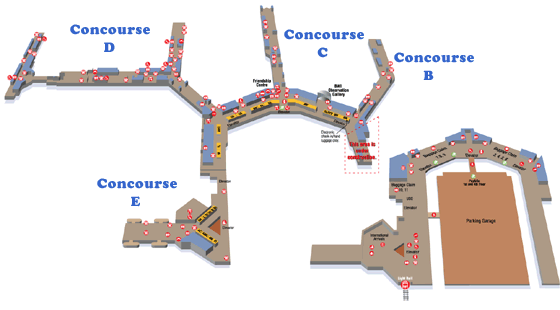
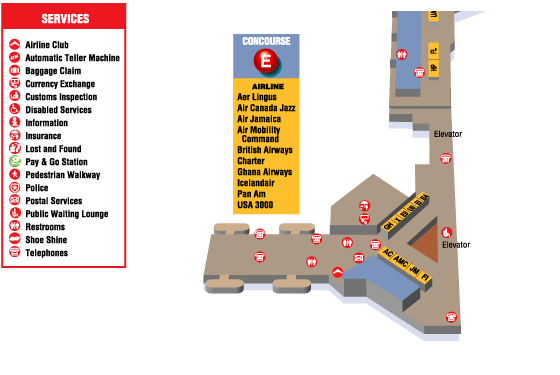
Baltimore, Maryland - BWI Airport Map

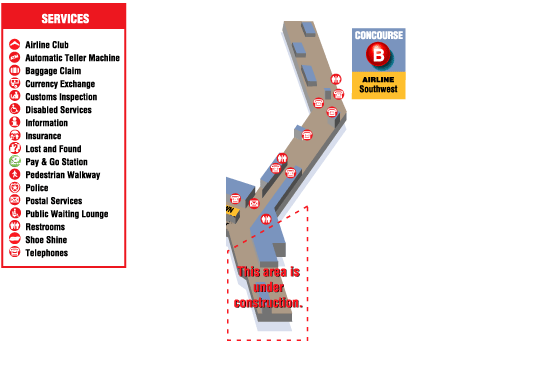
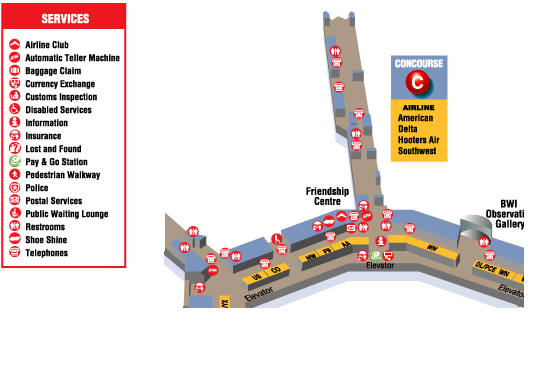
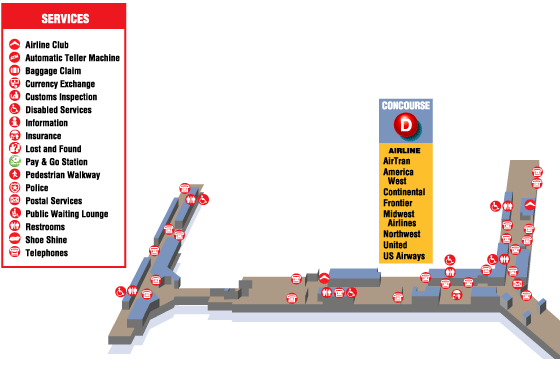
Baltimore, Maryland - Baltimore Int`l (BWI) Airport Information and Airport Layout

Airport Layout    Concourse B    Concourse C    Concourse D    Concourse E    


Airport Layout

Baltimore, Maryland (BWI) - Airport Parking Information and Parking Search

Airport:
Baltimore (BWI)

Arrival:*
    

Departure:


*Please enter the time you expect to arrive at the parking facility NOT your flight time.

Baltimore Airfares, Maryland (BWI) - Airfare Information and Airfare Search

 
Enter details
 
Select your merchants
 
Search & Book
Search Details


Calendar

Calendar


Sign up for our newsletter:
next
 
Merchant Selection
Select up to 4 sites at once!

Updating merchants for your search
 
cheapFlightSales
 
Kayak
 
SideStep
 
Expedia
 
Travelocity
 
Priceline
 
Cheapoair.com
 
OneTravel
 
Orbitz.com
 
Farecast
 
Cheaptickets.com
 
Travelgrove
 
Compare Selected


Attention!
Turn off pop-up blockers
click here for help


Today's Hot Deals Friday, 9/5/08
 
Become a Metafares affiliate via Travelgrove's Affiliate Program!United Sates Great Britain Spain Germany Italy France India 

Cheap Airfares to Baltimore, Maryland | Baltimore City Overview | Baltimore Airfare Search | Baltimore City Map | Baltimore BWI Airport | Baltimore City Weather

Cheap domestic flights to:
Baltimore Airfares | Boston Airfares | Minneapolis Airfares | Atlanta Airfares | Orlando Airfares | Chicago Airfares | San Francisco Airfares | Philadelphia Airfares | Los Angeles Airfares | Newark Airfares | Dallas Airfares | Fort Lauderdale Airfares | New York Airfares | Las Vegas Airfares | Seattle Airfares
Cheap international flights to:
Kharkov Airfares | Tokyo Airfares | Cancun Airfares | Manila Airfares | Bangkok Airfares | London Airfares | Sydney Airfares | Singapore Airfares